
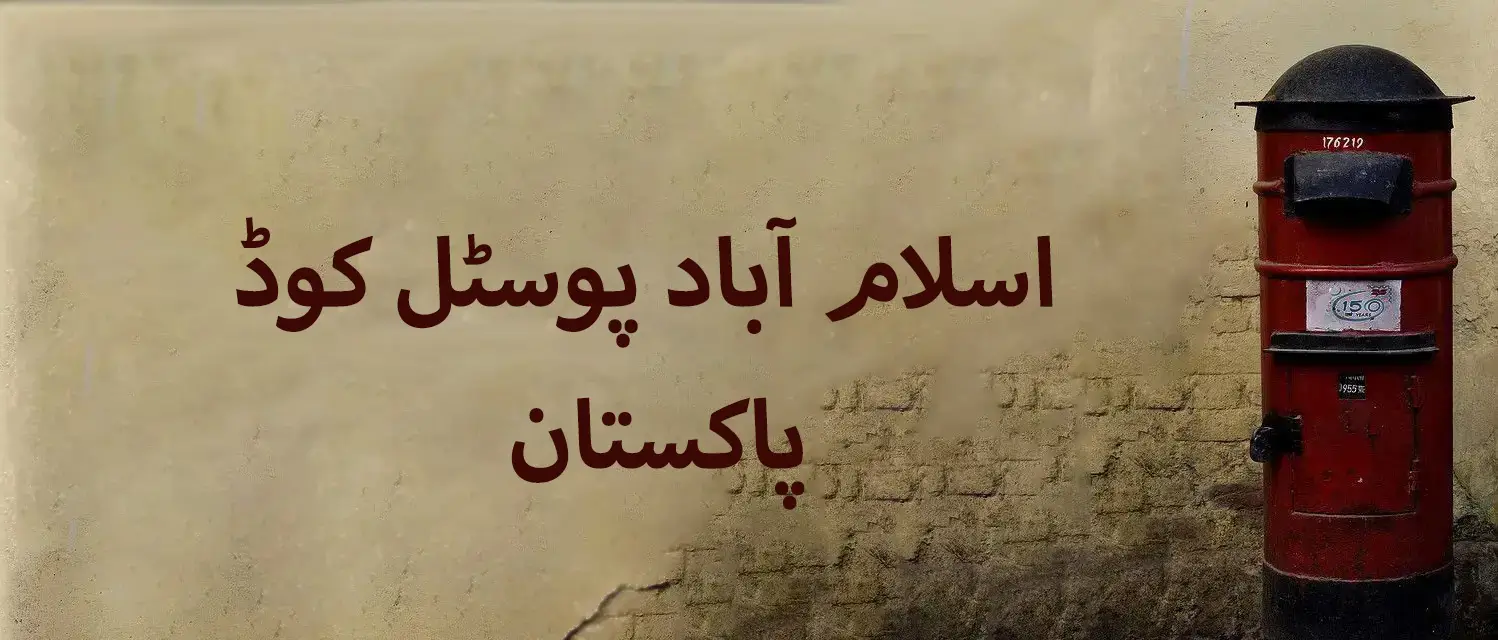
Islamabad Postal Codes Overview
Province / Territory: Islamabad Capital Territory, Pakistan
Capital City: Islamabad
Main Postal Code: 44000 (Islamabad GPO) – General Post Office for central Islamabad
Islamabad contains many delivery post offices that operate under the Islamabad General Post Office (GPO) system. Each sector or locality of the capital city has a specific postal code used for mail delivery. These postal codes help ensure efficient delivery of mail from major cities including:
- Karachi
- Lahore
- Peshawar
- Quetta
- Rawalpindi
and other parts of Pakistan.
Islamabad Postal Codes List Pakistan
| NAME OF DELIVERY POST OFFICE | POST CODE | ACCOUNT OFFICE | PROVINCE | BRANCH OFFICES |
| ALI PUR FRASH | 45600 | Islamabad GPO | Federal Capital | 45601 |
| BAGNIAL | 45240 | Islamabad GPO | Federal Capital | 45241 |
| BARA KAU | 45400 | Islamabad GPO | Federal Capital | 45401 |
| CHIRAH | 45680 | Islamabad GPO | Federal Capital | 45681 |
| GOLRA | 45200 | Islamabad GPO | Federal Capital | 45201 |
| HERDOGHER | 45800 | Islamabad GPO | Federal Capital | 45801 |
| ISLAMABAD AIWAN-E-SADDAR | 44040 | Islamabad GPO | Federal Capital | 44041 |
| ISLAMABAD ALLAMA IQBAL OPEN UNIVERSITY | 44310 | Islamabad GPO | Federal Capital | 44311 |
| ISLAMABAD B-BLOCK PAK SECTT. | 44020 | Islamabad GPO | Federal Capital | 44021 |
| ISLAMABAD DHA PHASE-II | 45730 | Islamabad GPO | Federal Capital | 45731 |
| ISLAMABAD E-9 (AIR HQ) | 44230 | Islamabad GPO | Federal Capital | 44231 |
| ISLAMABAD F-7 MARKAZ | 44210 | Islamabad GPO | Federal Capital | 44211 |
| ISLAMABAD F-8 MARKAZ | 44220 | Islamabad GPO | Federal Capital | 44221 |
| ISLAMABAD FEDERAL BOARD | 44320 | Islamabad GPO | Federal Capital | 44321 |
| ISLAMABAD G-10 MARKAZ | 44100 | Islamabad GPO | Federal Capital | 44101 |
| ISLAMABAD G-15 SECTOR | 44150 | Islamabad GPO | Federal Capital | 44151 |
| ISLAMABAD G-5 FOREIGN OFFICE | 44050 | Islamabad GPO | Federal Capital | 44051 |
| ISLAMABAD G-8/MARKAZ | 44080 | Islamabad GPO | Federal Capital | 44081 |
| ISLAMABAD G-9/MARKAZ | 44090 | Islamabad GPO | Federal Capital | 44091 |
| ISLAMABAD GPO | 44000 | Islamabad GPO | Federal Capital | 44001 |
| ISLAMABAD HAJJ COMPLEX | 45210 | Islamabad GPO | Federal Capital | 45211 |
| ISLAMABAD I-10/MARKAZ | 44800 | Islamabad GPO | Federal Capital | 44801 |
| ISLAMABAD I-8/4 | 44790 | Islamabad GPO | Federal Capital | 44791 |
| ISLAMABAD NATIONAL ASSEMBLY | 44030 | Islamabad GPO | Federal Capital | 44031 |
| ISLAMABAD NATIONAL HEALTH LABORATIORIES | 45500 | Islamabad GPO | Federal Capital | 45501 |
| ISLAMABAD PRIMR MINISTER SECTT. | 44010 | Islamabad GPO | Federal Capital | 44011 |
| ISLAMABAD QUIAID-E-AZAM UNIVERSITY | 45320 | Islamabad GPO | Federal Capital | 45321 |
| ISLAMABAD, MODEL TOWN HUMAK | 45700 | Islamabad GPO | Federal Capital | 45701 |
| JAGIOT, ISLAMABAD | 45610 | Islamabad GPO | Federal Capital | 45611 |
| KIRPA, ISLAMABAD | 45640 | Islamabad GPO | Federal Capital | 45641 |
| KURI, ISLAMABAD | 45570 | Islamabad GPO | Federal Capital | 45571 |
| LOHI BHER, ISLAMABAD | 45710 | Islamabad GPO | Federal Capital | 45711 |
| MALPUR, ISLAMABAD | 45520 | Islamabad GPO | Federal Capital | 45521 |
| MARA JAFFAR, ISLAMABAD | 45250 | Islamabad GPO | Federal Capital | 45251 |
| NILORE, ISLAMABAD | 45650 | Islamabad GPO | Federal Capital | 45651 |
| NOORPUR SHAHAN, ISLAMABAD | 45300 | Islamabad GPO | Federal Capital | 45301 |
| PAKISTAN TOWN (KORANG TOWN) | 45720 | Islamabad GPO | Federal Capital | 45721 |
| PIND MALKAN | 45624 | Islamabad GPO | Federal Capital | 45625 |
| RAWAL TOWN, ISLAMABAD | 45510 | Islamabad GPO | Federal Capital | 45511 |
| REWAT | 45900 | Islamabad GPO | Federal Capital | 45901 |
| SAREE CHOWK | 45410 | Islamabad GPO | Federal Capital | 45411 |
| SHAH ALLAH DITTA | 45220 | Islamabad GPO | Federal Capital | 45221 |
| SIHALA | 45750 | Islamabad GPO | Federal Capital | 45751 |
| SOHAN | 45740 | Islamabad GPO | Federal Capital | 45741 |
| TARLAI KALAN | 45550 | Islamabad GPO | Federal Capital | 45551 |
| TARNOL | 45230 | Islamabad GPO | Federal Capital | 45231 |
Islamabad Postal Codes – Complete Guide, Location, Population & District Overview
Postal codes in Pakistan are five-digit numbers used by the Pakistan Post for efficient sorting, routing, and delivery of mail and parcels across the country. Each city, sector, or locality is assigned a unique postal code to ensure that letters, documents, and packages reach the correct destination quickly and accurately.
Location & Status – Islamabad Postal Code
Islamabad is the capital city of Pakistan and serves as the administrative center of the country. The city is located in northern Pakistan within the Islamabad Capital Territory, near the foothills of the Margalla Hills.
Islamabad lies approximately:
- 14 km from Rawalpindi
- 375 km from Lahore
- 1,140 km from Karachi
The capital city was developed as a planned urban center to replace Karachi as Pakistan’s capital during the 1960s. Due to its organized layout, modern infrastructure, and scenic surroundings, Islamabad is considered one of the most beautiful and well-planned cities in South Asia.
Population – Islamabad Postal Code
Islamabad City
Population (2017 Census estimate): Approximately 1.0 million residents
Islamabad Capital Territory
Total Population (2017 Census): Approximately 2.0 million people. The population includes residents of:
- urban sectors of Islamabad
- suburban villages
- surrounding rural settlements
Due to government employment, diplomatic missions, universities, and corporate offices, Islamabad attracts people from across Pakistan.
Administrative Structure – Islamabad Capital Territory
Unlike most cities in Pakistan, Islamabad is not part of a province. Instead, it is administered as a federal territory known as the: Islamabad Capital Territory.
Governing Authority
The city is managed by the:
- Capital Development Authority (CDA)
This authority oversees:
- city planning
- infrastructure development
- land management
- municipal services
Administrative Divisions
Islamabad Capital Territory consists of several zones:
- Urban sectors (F, G, H, I sectors)
- Suburban areas
- Rural villages
- National parks and protected areas
The city is divided into planned sectors, each identified by a letter and number such as F-6, G-10, or I-8. Each sector typically includes:
- residential areas
- markets
- schools
- parks
- mosques
This grid-based sector design makes Islamabad unique among Pakistani cities.
Geography & Environment – Islamabad City
Area
Islamabad Capital Territory covers approximately: 906 square kilometres
Terrain
The region includes a mixture of:
- forested hills
- plains
- streams
- natural reserves
The most prominent geographic feature is the Margalla Hills National Park, which lies north of the city.
Natural Attractions
Important natural locations include:
- Daman-e-Koh
- Pir Sohawa
- Rawal Lake
These scenic areas make Islamabad a major tourist destination.
Climate – Islamabad
Islamabad has a humid subtropical climate.
Summer
Temperatures may reach: 35–40°C
Winter
Temperatures can drop to: 3–5°C
Monsoon
Islamabad receives significant rainfall during the South Asian monsoon season, especially between July and September. Compared to many Pakistani cities, Islamabad has:
- cleaner air
- greener landscapes
- moderate weather
Historical Background – Islamabad
Before the construction of Islamabad, the capital of Pakistan was Karachi. In 1959, the government of Pakistan decided to build a new capital city closer to the center of the country. The planning and design of Islamabad were led by the Greek architect: Constantinos Apostolou Doxiadis.
Construction began in the early 1960s. Islamabad was designed as a modern planned city, with carefully organized sectors, green spaces, and wide roads. The capital officially became the seat of the government during the 1960s. Important national institutions were built here, including:
- Parliament House
- Supreme Court of Pakistan
- Pakistan Secretariat
Today Islamabad serves as the political and administrative center of Pakistan.
Culture & Languages – Islamabad City
Because Islamabad is the capital city, it is one of the most diverse cities in Pakistan. People from all provinces live here.
Widely Spoken Languages
- Urdu
- Punjabi
- Pashto
- Hindko
- English
Official Language
The official national language is: Urdu. English is widely used in government, education, and business sectors.
Landmarks & Important Places – Islamabad City
Islamabad is home to many iconic landmarks.
Faisal Mosque
The most famous landmark is the: Faisal Mosque It is:
- the largest mosque in Pakistan
- one of the largest mosques in the world
The mosque was funded by King Faisal of Saudi Arabia.
Pakistan Monument
Another important landmark is the: Pakistan Monument. This monument symbolizes the unity of Pakistan’s provinces.
Lok Virsa Museum
The Lok Virsa Museum showcases the cultural heritage of Pakistan.
Economy & Daily Life – Islamabad
Islamabad’s economy is primarily based on:
- government services
- diplomatic missions
- education sector
- information technology
- tourism
- corporate offices
Major government ministries and departments are headquartered in the capital city. The presence of embassies and international organizations makes Islamabad an important diplomatic hub. Many people from nearby cities such as Rawalpindi commute daily to Islamabad for work.
Education in Islamabad
Islamabad is known for its high-quality educational institutions. Major universities include:
- Quaid-i-Azam University
- National University of Sciences and Technology
- International Islamic University Islamabad
These universities attract students from across Pakistan and abroad.
Transportation – Islamabad
Islamabad has a modern transportation system. Major highways connect it to other cities, including:
- Motorway M‑1
- Motorway M‑2
The city also has the Rawalpindi–Islamabad Metrobus, which provides public transportation between Islamabad and Rawalpindi.
The main airport serving the capital is: Islamabad International Airport.
Frequently Asked Questions (FAQs) – Islamabad
1. Where is Islamabad located?
Islamabad is located in northern Pakistan within the Islamabad Capital Territory, near the Margalla Hills.
2. What is the postal code of Islamabad?
The main postal code for Islamabad is:
44000 (Islamabad GPO)
Different sectors and localities have additional postal codes.
3. What is the population of Islamabad?
Islamabad city has approximately 1 million residents, while the Islamabad Capital Territory has around 2 million people according to the 2017 census.
4. Why was Islamabad built?
Islamabad was developed in the 1960s to replace Karachi as the capital of Pakistan and to create a modern, centrally located administrative city.
5. What is Islamabad famous for?
Islamabad is known for:
- its modern urban planning
- scenic natural surroundings
- diplomatic and government institutions
- landmarks like Faisal Mosque and Pakistan Monument
6. What languages are spoken in Islamabad?
Common languages include:
- Urdu
- Punjabi
- Pashto
- Hindko
- English
7. What is the climate like in Islamabad?
Islamabad experiences:
- warm summers
- cool winters
- heavy monsoon rainfall
8. Is Islamabad an important city in Pakistan?
Yes. Islamabad is the capital city of Pakistan and serves as the country’s political, administrative, and diplomatic center.




%20–%20General%20Post%20Office%20for%20central%20Islamabad%20Islamabad%20contains%20many%20delivery%20post%20offices%20that%20operate%20under%20the%20Islamabad%20General%20Post%20Office%20(GPO)%20system.%20Each%20sector%20or%20locality%20of%20the%20capital%20city%20has%20a%20specific%20postal%20code%20used%20%5B…%5D&media=https://nigarcraft.com.pk/wp-content/uploads/2026/03/Islamabad-Postal-Code.webp)