
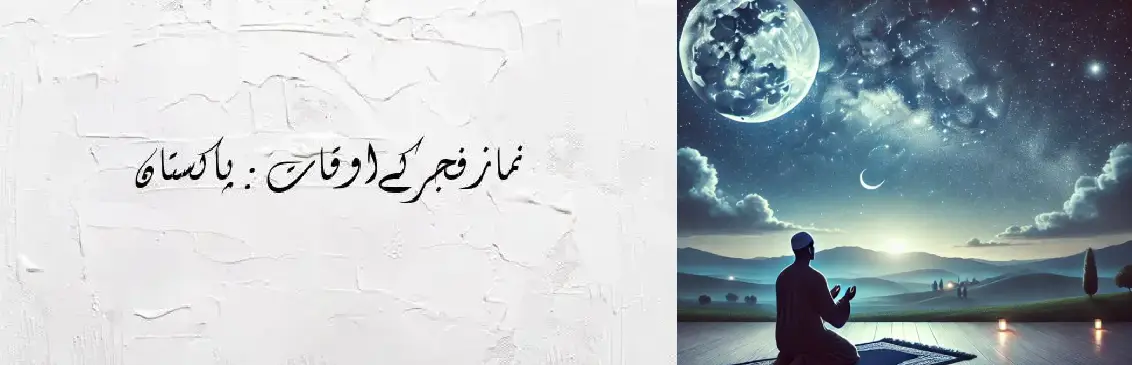
Fajr Time in Pakistan — City Wise
Fajr Time in Pakistan: Understanding the Timing, Variations, and Importance
Fajr, the first of the five daily prayers in Islam, holds significant spiritual and practical importance for Muslims across the world, including Pakistan. It is the prayer performed at dawn, marking the start of a new day and the beginning of a believer’s routine of worship. Observing Fajr not only fulfills a core religious obligation but also instills discipline, mindfulness, and connection with Allah from the very first hours of the morning. In Pakistan, like in other parts of the Muslim world, the timing of Fajr prayer is not fixed to the clock in the Gregorian sense—it changes daily, seasonally, and geographically.
When is Fajr Observed?
Fajr prayer is observed at the break of dawn, just before the sun rises above the horizon. Technically, it begins when the first light appears horizontally along the horizon, signaling the beginning of the day. This light is called Al-Fajr al-Sadiq, or “true dawn,” and it appears before sunrise. In Pakistan, the exact time of Fajr varies based on latitude, longitude, altitude, and the time of year.
For example, in Karachi, located closer to the equator, the length of daylight remains relatively stable throughout the year, so the Fajr timing shifts gradually. In contrast, northern cities like Islamabad or Peshawar experience more pronounced variations in daylight hours between winter and summer. During winter, Fajr occurs later in the morning due to delayed dawn, while in summer, it can start very early, sometimes around 3:50 AM, reflecting the longer daylight hours.
Fajr continues until sunrise, after which performing it is considered less desirable and eventually invalid for the day. Hence, it is essential for Muslims to know the exact timing each day to ensure their prayers are performed at the correct time.
How Fajr Time is Determined
The timing of Fajr is scientifically and astronomically calculated using the position of the sun relative to the horizon. The process involves:
- Observation of Astronomical Twilight: Fajr begins at the start of astronomical twilight, defined as when the sun is approximately 18 degrees below the horizon. This is the point when the sky begins to lighten but before the sun itself becomes visible.
- Geographical Coordinates: The latitude and longitude of each city are critical. Pakistan spans several degrees of latitude and longitude, so cities like Karachi, Lahore, Islamabad, Peshawar, Quetta, and Multan all have slightly different sunrise and dawn times, which directly affect Fajr timing.
- Seasonal Changes: Due to the Earth’s axial tilt, the angle of the sun relative to the horizon changes throughout the year. This tilt causes earlier dawns in the summer and later dawns in the winter. For instance, Fajr in Karachi in June may be around 4:20 AM, whereas in December, it might be closer to 5:50 AM.
- Calculation Methods: Islamic scholars and astronomers use various methods to calculate Fajr times, known as prayer calculation methods. In Pakistan, common methods include the University of Islamic Sciences, Karachi method, which uses a 18-degree angle for Fajr, and others that may use slightly different angles (e.g., 15 or 19 degrees) depending on the local jurisprudence.
- Tools and Technology: Today, most people rely on digital tools, apps, and websites such as Nigar Craft, local mosques, and Islamic centers to determine precise Fajr timings. These sources combine astronomical calculations with local coordinates to provide accurate prayer times for each city.
Why Fajr Time Changes Daily
The daily and seasonal variation of Fajr prayer is a natural consequence of the Earth’s rotation, axial tilt, and orbit around the sun. Unlike the Gregorian calendar, which divides time into fixed hours and minutes, Fajr depends on solar position. Key reasons for variation include:
- Earth’s Tilt: The 23.5-degree tilt of the Earth causes the length of day and night to vary throughout the year. In summer, days are longer, leading to earlier dawns, whereas in winter, shorter days push dawn later.
- Latitude Differences: Cities at higher latitudes, such as Islamabad, experience more extreme variations in daylight compared to southern cities like Karachi.
- Horizon Obstructions: Mountains, tall buildings, or atmospheric conditions can slightly affect the observed time of Fajr in specific locations, although calculations generally account for standard horizons.
- Islamic Calendar Influence: Although the Islamic (Hijri) calendar is lunar-based and does not directly affect Fajr, seasonal shifts in the Gregorian calendar indirectly influence the prayer time as days get longer or shorter.
Importance of Accurate Fajr Timing
Knowing the exact time for Fajr is crucial for both spiritual and practical reasons:
- Spiritual Benefits: Performing Fajr at its prescribed time is a Sunnah and considered highly rewarding. It sets a spiritual tone for the day, encouraging mindfulness, patience, and discipline. The Prophet Muhammad (PBUH) emphasized the virtue of early morning prayer, linking it to peace, divine blessings, and protection from sin.
- Fasting in Ramadan: Fajr marks the beginning of the daily fast during Ramadan. Muslims begin their fast (Sehri/Suhur) before Fajr, making the precise timing critical to ensure the fast is valid.
- Daily Routine and Discipline: For many Pakistanis, especially students, professionals, and those following religious schedules, Fajr timing influences sleep patterns, meal times, and daily productivity.
- Community Synchronization: Accurate Fajr timings ensure that local mosques can call the Adhan (prayer call) on time, keeping communities synchronized for congregational prayers.
Practical Tips for Observing Fajr
- Check Updated Timings Daily: As Fajr changes minute by minute, checking sources like Nigar Craft or local Islamic centers daily ensures accuracy.
- Use Technology: Mobile apps, websites, or automated clocks adjusted for Islamic prayer times can provide reminders and alerts.
- Consider Local Adjustments: Sometimes, mosques adjust Fajr slightly for local visibility or community convenience, so always follow trusted local announcements.
Conclusion
In Pakistan, Fajr prayer is much more than just an early morning ritual—it is a spiritual anchor, a time for reflection, and a practice that structures the day. Its timing varies due to astronomical factors, geographical location, and seasonal changes, reflecting the intricate connection between nature, science, and religious observance. Whether in Karachi, Lahore, Islamabad, or Peshawar, Muslims rely on precise calculations and daily updates from trusted sources like Nigar Craft to ensure they perform their prayers on time.





Comments are closed.