The Shah Faisal Mosque stands as one of the most iconic religious landmarks in Pakistan and a defining symbol of Islamabad, the country’s federal capital. Recognized as the national mosque of Pakistan, it is among the largest mosques in the Islamic world, with a total capacity of approximately 300,000 worshippers across its prayer halls, courtyards, and surrounding grounds.
Located at the foothills of the Margalla Hills, the Faisal Mosque Margalla Hills is not only a place of worship but also a masterpiece of modern Islamic architecture, attracting visitors, scholars, and tourists from around the globe.
Global Ranking and Capacity
The Faisal Mosque Islamabad is:
- The largest mosque in Pakistan
- The largest mosque in South Asia
- Among the largest mosques globally by capacity
At peak times—such as Eid prayers, Jummah tul Wida, and national religious gatherings—the mosque can accommodate up to 3 lakh (300,000) worshippers, making it one of the most expansive congregational spaces in the Muslim world.
Naming and Saudi–Pakistani Brotherhood
The mosque is named after King Faisal bin Abdul Aziz Al Saud, the late King of Saudi Arabia, who played a pivotal role in its creation. During his official visit to Pakistan in 1966, King Faisal proposed the construction of a grand national mosque as a symbol of Islamic unity and brotherhood.
Saudi Arabia funded the project almost entirely, contributing the lion’s share of the construction cost as a gift to the people of Pakistan. Following King Faisal’s assassination in 1975, both the mosque and the main avenue leading to it were named in his honor.
Location and Natural Setting
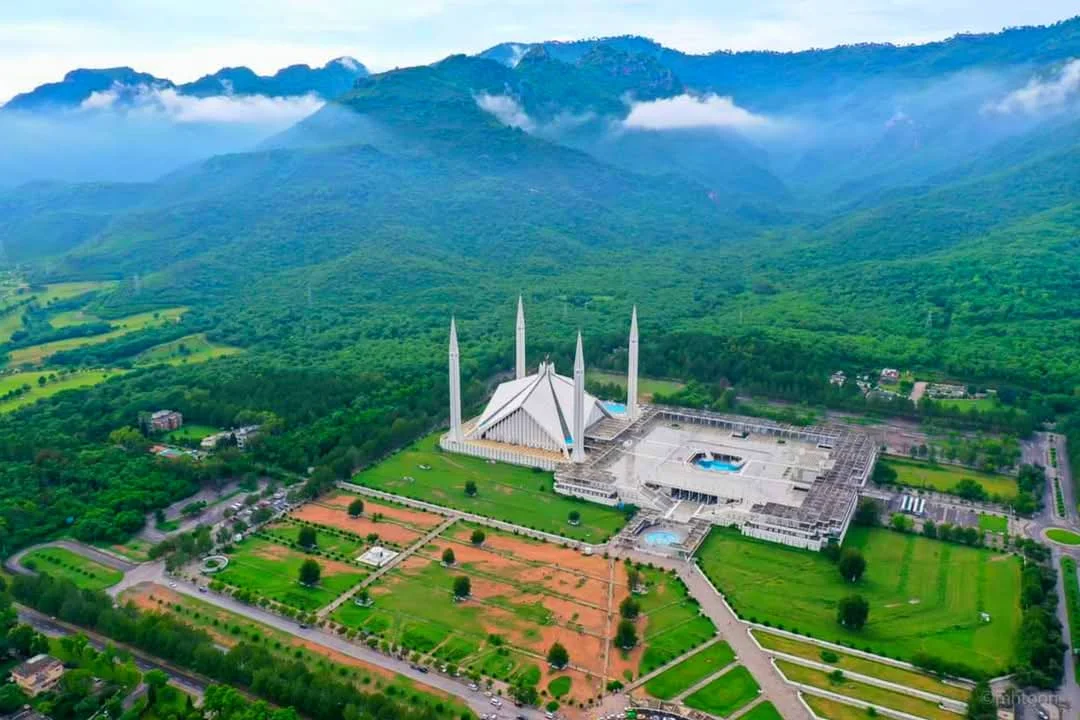
The Shah Faisal Mosque is situated at the northern end of Faisal Avenue (Shahrah-e-Islamabad), in Sector E-8, Islamabad. Built on elevated land at the lower slopes of the Margalla Hills, its location offers breathtaking panoramic views and ensures the mosque remains visible from miles away.
The contrast between the white marble structure and the green hills behind it creates one of the most photographed cityscapes in Pakistan.
Faisal Mosque Architecture Vision and Design Concept
The architectural design of the Faisal Mosque was created by renowned Turkish architect Vedat Dalokay, selected through an international design competition.
Unlike traditional mosques that feature domes and arches, Dalokay introduced a bold, unconventional concept inspired by:
- A Bedouin desert tent
- Modern Islamic geometry
- Turkish architectural principles
The result is an eight-sided concrete prayer hall, symbolizing simplicity, unity, and the nomadic origins of early Islamic culture.
Minarets and Structural Features
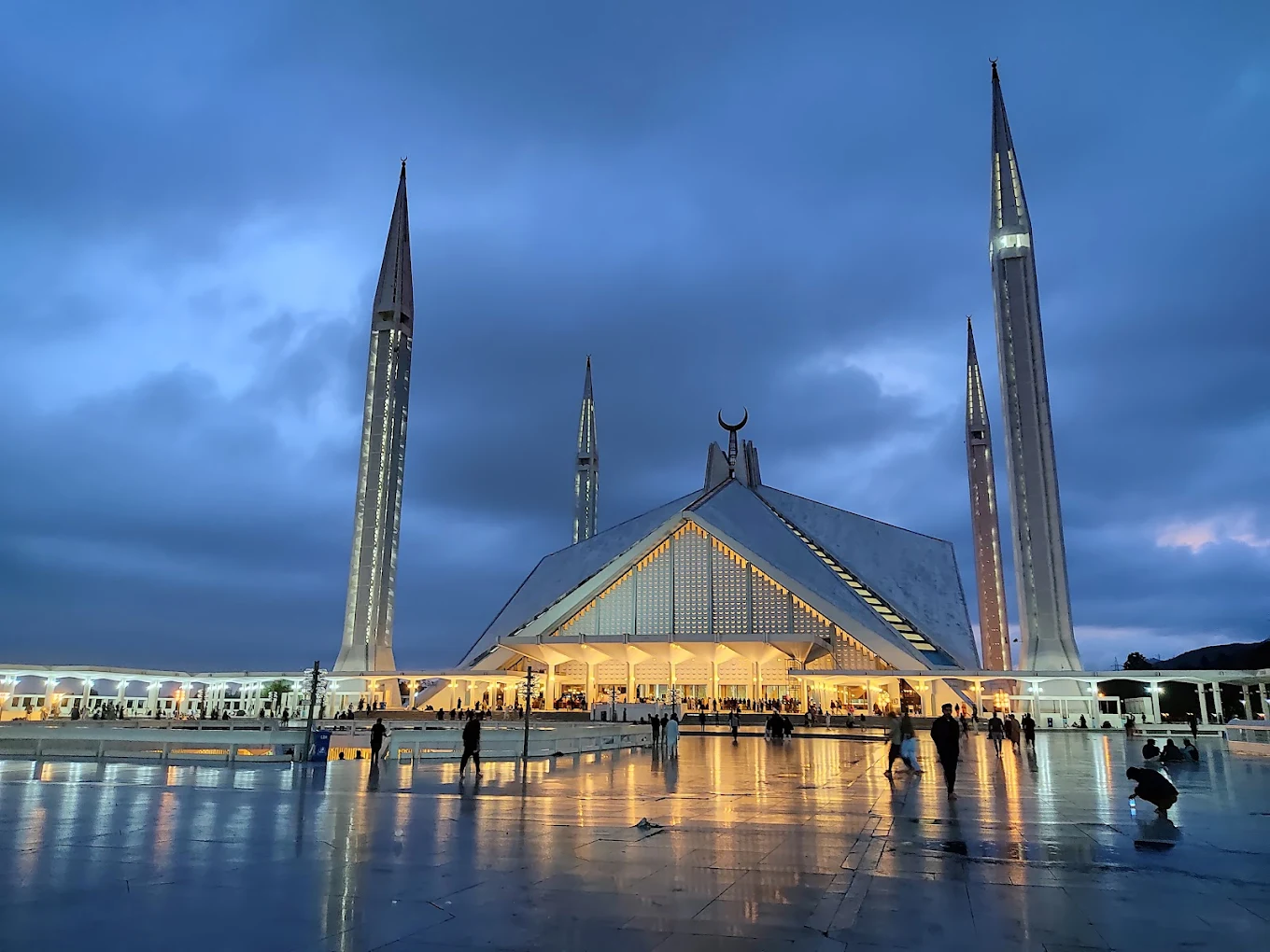
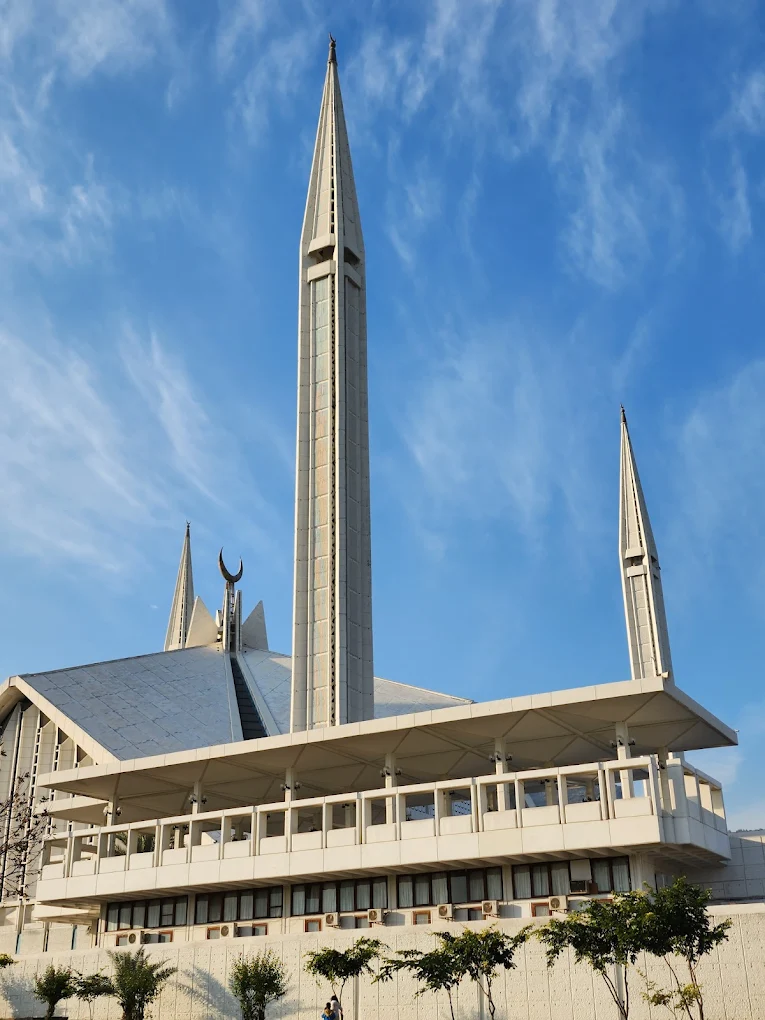
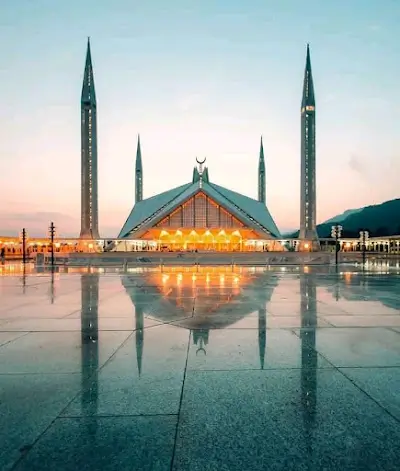
One of the mosque’s most striking features is its four tall, pencil-shaped minarets, inspired by classical Turkish mosques.
- Height: Approximately 79–90 meters
- Design: Slender, pointed, and minimalist
- Significance: Among the tallest minarets in South Asia
The mosque deliberately rejects the traditional dome, making it one of the most distinctive Islamic structures of the 20th century.
Interior Art and Craftsmanship
The entire mosque is clad in white marble, enhancing its purity and monumental scale. The interior is enriched with:
- Quranic calligraphy and mosaics by legendary Pakistani artist Sadequain
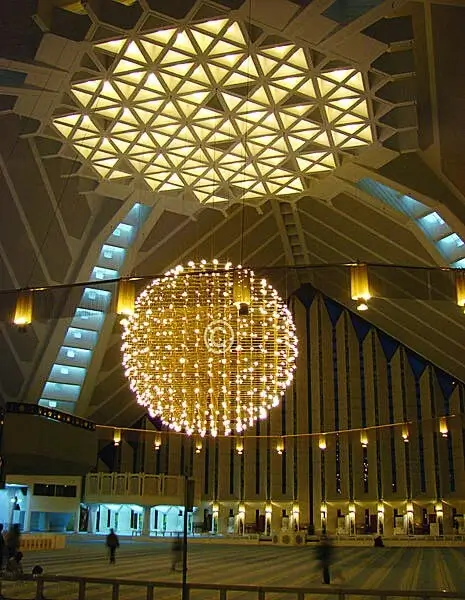
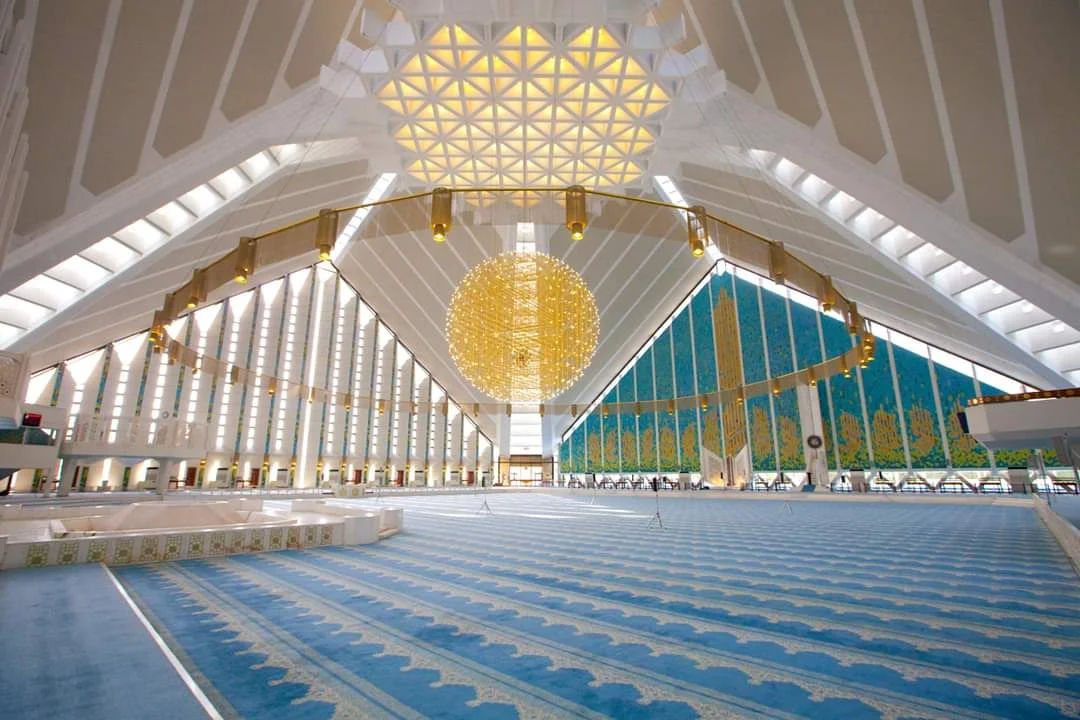
- A magnificent Turkish-style chandelier suspended from the main prayer hall
- Minimalist geometric detailing that emphasizes light, space, and spirituality
The restrained interior design reflects a balance between modern aesthetics and Islamic tradition.
Recognition and Architectural Legacy
Due to its groundbreaking design, Vedat Dalokay was awarded the Aga Khan Award for Architecture, one of the most prestigious honors in Islamic architectural history.
Architectural critics and scholars often rank the Faisal Mosque Islamabad among the most important mosques ever constructed for its departure from convention, structural innovation, and symbolic depth.
Cultural and Tourism Importance
Beyond its religious role, the Shah Faisal Mosque is:
- A major tourist attraction
- A symbol of Pakistan’s peaceful and spiritual identity
- A landmark frequently visited by international dignitaries, scholars, and religious leaders
It presents Pakistan as a country of architectural sophistication, natural beauty, and cultural depth.
Shah Faisal Mosque Islamabad – History, Construction & Religious Importance
The Shah Faisal Mosque Islamabad is not only an architectural marvel but also a site deeply rooted in Pakistan’s religious, political, and cultural history. From its conception in the 1960s to its completion in the 1980s, the mosque reflects the vision of a young Islamic republic seeking a powerful national symbol.
Historical Background and Vision – Faisal Mosque Margalla Hills
The idea for the national mosque of Pakistan was formally proposed in 1966, during the official visit of King Faisal bin Abdul Aziz of Saudi Arabia to Pakistan. Recognizing Islamabad as the future heart of the nation, King Faisal strongly supported the construction of a grand mosque that would symbolize Islamic unity, faith, and modern progress.
Following this initiative, the Government of Pakistan announced an international architectural competition in 1969, attracting architects from 17 countries. Out of 43 submitted designs, the bold and unconventional proposal by Turkish architect Vedat Dalokay was selected.
Construction Timeline and Funding
Construction of the Faisal Mosque began in 1976, primarily funded by the Government of Saudi Arabia at a cost exceeding 130 million Saudi Riyals.
Key milestones include:
- 1975 – King Faisal was assassinated; the mosque was officially named in his honor
- 1976 – Foundation stone laid by King Khalid bin Abdul Aziz, successor to King Faisal
- 1986 – Construction completed
- 1988 – First congregational prayer offered
For several years after completion, the mosque complex also housed the International Islamic University, which later relocated to a dedicated campus in 2000.
Prayer Spaces and Congregational Areas
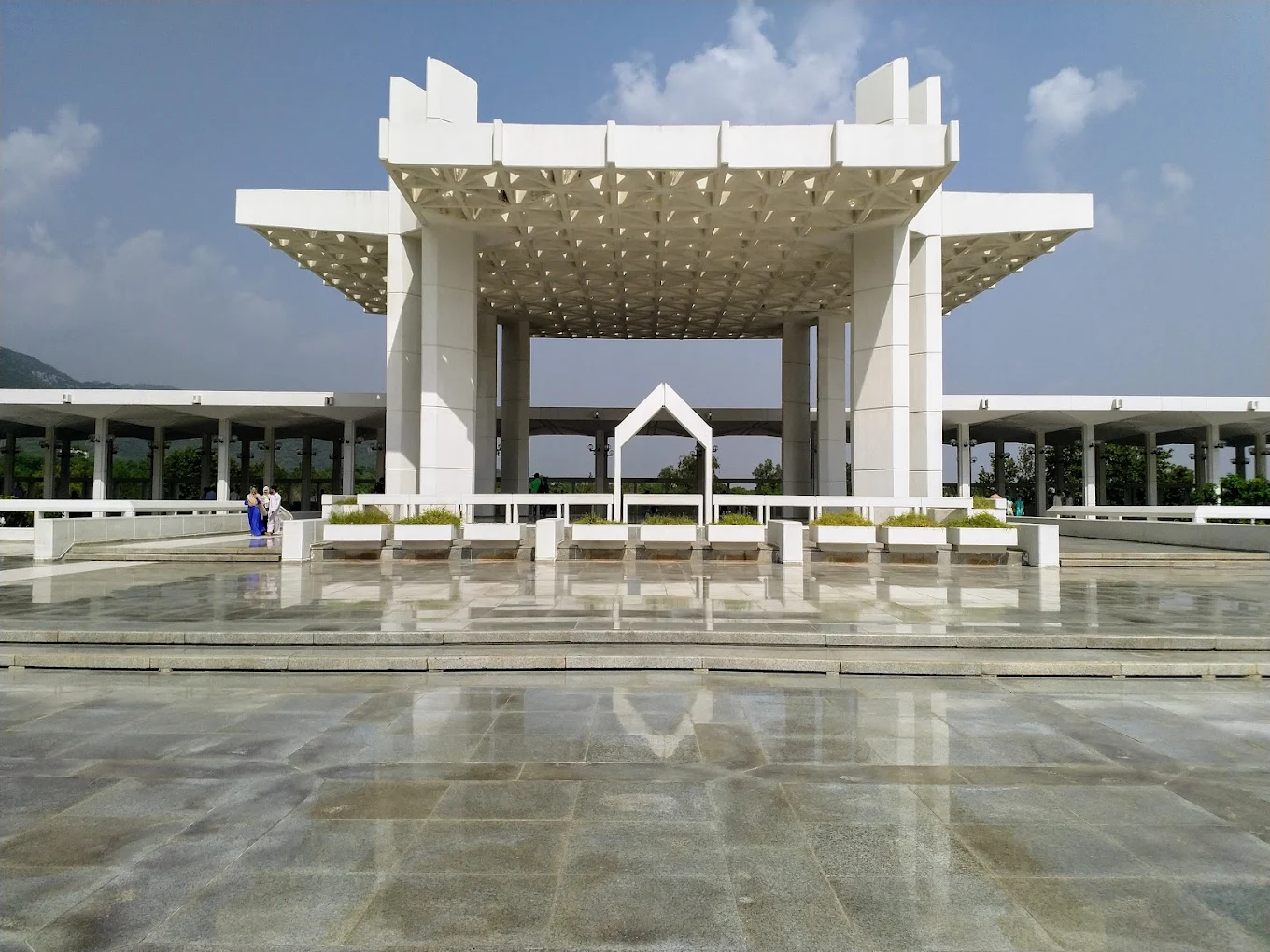
The Shah Faisal Mosque is designed to accommodate massive congregations, especially during Eid prayers, Friday prayers, and national religious events.
- Main prayer hall capacity: ~10,000 worshippers
- Porticoes: ~24,000 worshippers
- Courtyard and surrounding grounds: ~200,000+ worshippers
- Total capacity: Approximately 300,000 worshippers
This makes the Faisal Mosque one of the largest congregational prayer spaces in the Islamic world.
Religious Importance and Events
As Pakistan’s national mosque, the Faisal Mosque holds immense religious importance. Special prayers are offered here during:
- Eid-ul-Fitr
- Eid-ul-Adha
- Jummah-tul-Wida
- National religious occasions
Prominent religious scholars and international Islamic figures, including Imam-e-Kaaba, have visited the mosque, further enhancing its global standing.
Mausoleum of General Zia-ul-Haq
Located within the mosque complex is the mausoleum of General Muhammad Zia-ul-Haq, President of Pakistan from 1978 to 1988. The site is frequently visited by people who stop to offer fateha (prayer for the deceased).
The presence of the mausoleum adds historical and political significance to the mosque grounds.
Shah Faisal Mosque as a National Landmark
Today, the Shah Faisal Mosque Islamabad is:
- A religious center
- A national symbol
- A tourism landmark
- A globally recognized example of modern Islamic architecture
Its strategic location, massive scale, and distinctive design have made it one of the most photographed and visited sites in Pakistan.
Shah Faisal Mosque Islamabad – Architecture, Symbolism & Artistic Mastery
The Shah Faisal Mosque Islamabad stands apart from traditional mosque architecture, representing a bold fusion of modern engineering and Islamic symbolism. Designed to break away from conventional domes and arches, the mosque embodies spiritual purity, geometric harmony, and national identity.
Revolutionary Architectural Concept
Unlike classical Islamic mosques, the Faisal Mosque deliberately avoids the use of a central dome. Instead, Turkish architect Vedat Dalokay drew inspiration from the Bedouin desert tent, symbolizing simplicity, shelter, and unity under faith.
The mosque’s eight-sided concrete shell rises dramatically against the Margalla Hills, creating a powerful visual metaphor for the Kaaba’s geometric purity—abstracted into a modern form.
Dalokay himself stated that his goal was to capture:
“The spirit, proportion, and geometry of the Kaaba in a purely abstract manner.”
Minarets: Turkish Influence and Vertical Power
The four minarets of the Shah Faisal Mosque are among the tallest in South Asia.
- Height: Approximately 79–90 meters (259–300 feet)
- Shape: Slender, pencil-like form
- Design Influence: Classical Turkish Ottoman minarets
Each minaret rises from a square base formed by intersecting planes, reinforcing both structural stability and symbolic balance. At night, the illuminated minarets transform the mosque into a beacon visible across Islamabad.
Interior Design and Sacred Art
The interior of the Faisal Mosque is intentionally minimal yet spiritually rich.
Calligraphy by Sadequain
The western wall of the prayer hall features breathtaking Quranic calligraphy by renowned Pakistani artist Sadequain, rendered in Kufic script. The mirrored composition creates visual symmetry, reinforcing the theme of divine order.
Mosaics and Color Palette
The interior mosaics incorporate deep spiritual hues:
- Cerulean and cobalt blue
- Olive and emerald green
- Golden yellow and warm earth tones
These colors symbolize divinity, growth, illumination, and eternity.
Turkish Chandeliers and Ceiling Design
Suspended from the soaring 40-meter-high ceiling is a grand Turkish-style chandelier, surrounded by smaller matching fixtures. The lighting arrangement enhances:
- Vertical height perception
- Calm spiritual ambiance
- Architectural rhythm of the ceiling panels
The absence of a dome allows uninterrupted visual flow upward, directing focus toward spiritual contemplation rather than ornamentation.
Structural Engineering Excellence
The mosque’s massive concrete shell is supported by four giant reinforced concrete girders, an engineering achievement that allows the vast prayer hall to remain column-free.
Key structural features include:
- Isosceles triangular walls
- Pyramidal roof with gabled intersections
- White Thassos marble cladding
The roof’s geometric pattern forms a subtle network of vertical and horizontal lines visible even from a distance.
Courtyards, Water Features, and Landscape Design
The mosque complex spans approximately 33 acres, integrating architecture with nature.
- Spacious marble courtyards
- Porticoes for overflow congregations
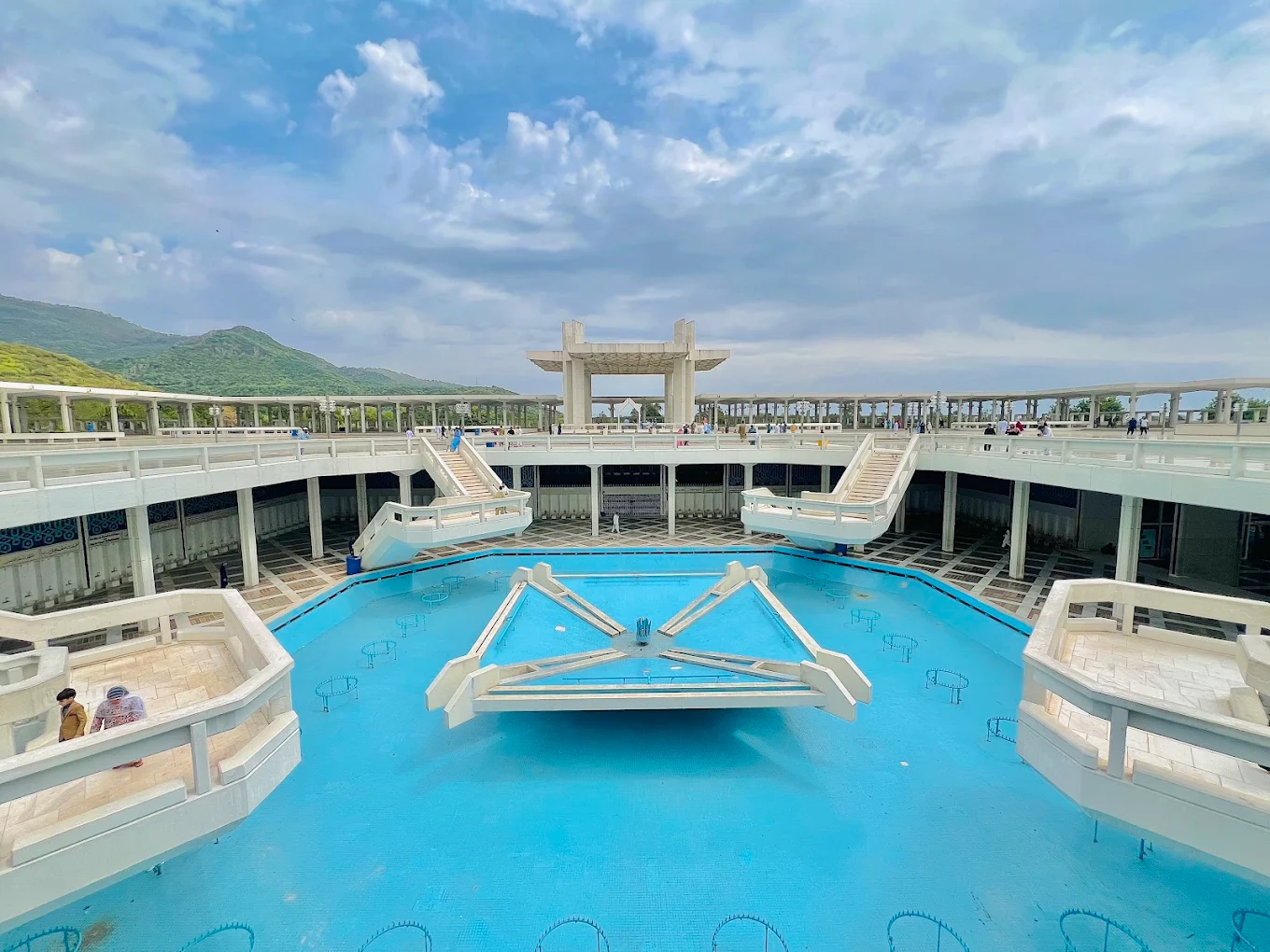
- Reflecting pools and fountains
- Terraced platforms aligned with the Margalla Hills
This harmonious layout enhances tranquility and reinforces the mosque’s spiritual connection with its natural surroundings.
Global Recognition and Architectural Legacy
The architectural brilliance of the Shah Faisal Mosque Islamabad earned Vedat Dalokay the Aga Khan Award for Architecture, one of the most prestigious honors in the Islamic architectural world.
In 2021, the mosque was also ranked among the 50 most beautiful buildings in the world, based on studies analyzing architectural balance using the Golden Ratio.
A Symbol of Faith and National Identity
Today, the Shah Faisal Mosque is more than a place of worship. It represents:
- Pakistan’s Islamic identity
- Architectural modernization of Muslim societies
- Unity between Saudi generosity, Turkish design, and Pakistani craftsmanship
Its distinctive form continues to inspire architects, scholars, travelers, and worshippers from across the globe.
Shah Faisal Mosque Islamabad – Visiting Guide, Tourism Value & Cultural Experience
The Shah Faisal Mosque Islamabad is not only Pakistan’s national mosque but also one of the most visited landmarks in the country. Nestled against the Margalla Hills, it offers visitors a rare blend of spiritual serenity, architectural grandeur, and scenic beauty.
Visiting Shah Faisal Mosque Islamabad
One of the most appealing aspects of the Shah Faisal Mosque Islamabad is that it is open to the public throughout the year.
Entry & Timings
- Entry Fee: Free
- Daily Access: Open from Fajr to Isha prayers
- Best Time to Visit: Early morning or sunset for peaceful ambiance
Friday afternoons are generally crowded due to Jummah prayers, while Eid days witness massive congregations.
Visitor Guidelines and Etiquette
As an active place of worship, visitors are expected to follow Islamic etiquette:
- Remove footwear before entering prayer areas
- Dress modestly (full sleeves recommended)
- Women must cover their heads
- Maintain silence inside the prayer hall
- Photography inside the main prayer hall is prohibited
- Non-Muslim visitors may view the mosque but are not allowed inside the main prayer hall during prayers
Following these guidelines ensures respect for the sanctity of the mosque.
Spiritual Experience and Atmosphere
The spiritual environment of the Shah Faisal Mosque is deeply calming. The open design, absence of pillars, and soft lighting create an atmosphere of reflection and peace.
During Ramadan, the mosque becomes a center of:
- Quran recitation
- Religious lectures
- Taraweeh prayers
The experience of praying here, especially at night under illuminated minarets, is often described as transformative.
Photography and Scenic Views
Although photography is restricted inside the prayer hall, the exterior of Shah Faisal Mosque Islamabad is one of the most photographed scenes in Pakistan.
Popular photography spots include:
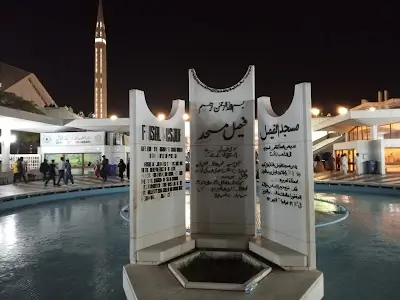
- Main courtyard and entrance pools
- Side terraces facing Margalla Hills
- Viewpoints from Daman-e-Koh
At night, the mosque glows brilliantly, creating a postcard-worthy skyline.
Nearby Attractions Around Faisal Mosque
The mosque’s central location makes it an excellent starting point for exploring Islamabad.
Nearby attractions include:
- Daman-e-Koh: 7.6 km
- Margalla Hills National Park: Adjacent
- Fatima Jinnah Park: 6.8 km
- Centaurus Mall: 3.5 km
- Pakistan Monument: 8.2 km
These nearby sites allow visitors to combine religious tourism with leisure and nature exploration.
Shah Faisal Mosque as a Tourism Icon
The Shah Faisal Mosque Islamabad is frequently listed among:
- Top tourist attractions in Pakistan
- Most beautiful mosques in the world
- Best examples of modern Islamic architecture
It attracts:
- Local worshippers
- International tourists
- Architecture students
- Religious scholars
The mosque serves as a bridge between faith, culture, and modern design.
Cultural Significance for Pakistan
For Pakistanis, the Shah Faisal Mosque represents:
- National pride
- Islamic unity
- International friendship (Saudi-Pak relations)
It stands as a reminder of Pakistan’s commitment to Islamic values while embracing modernity.
Conclusion: The Enduring Legacy of Shah Faisal Mosque Islamabad
The Shah Faisal Mosque Islamabad is far more than a place of worship—it is a symbol of Pakistan’s religious identity, architectural ambition, and global Islamic presence. Rising gracefully at the foothills of the Margalla Hills, the mosque reflects a rare harmony between modern design and timeless spiritual values. Its tent-shaped structure, soaring minarets, and minimalist interior redefine Islamic architecture while preserving its sacred essence.
As Pakistan’s national mosque, the Shah Faisal Mosque Islamabad continues to unite faith, culture, and history under one monumental roof. From hosting some of the largest congregations in the Islamic world to welcoming visitors from across the globe, it stands as a testament to unity, devotion, and visionary architecture. Whether viewed as a spiritual sanctuary, a national landmark, or a masterpiece of contemporary Islamic design, Shah Faisal Mosque remains one of the most powerful and enduring symbols of Pakistan.
Frequently Asked Questions (FAQ) about Shah Faisal Mosque
1. What is the Shah Faisal Mosque?
The Shah Faisal Mosque is Pakistan’s national mosque, an iconic religious landmark, and a defining symbol of Islamabad. It is recognized as one of the largest mosques in the Islamic world by capacity and a masterpiece of modern Islamic architecture.
2. Where is the Shah Faisal Mosque located?
It is situated at the northern end of Faisal Avenue (Shahrah-e-Islamabad) in Sector E-8, Islamabad, at the foothills of the Margalla Hills. Its elevated location offers panoramic views and makes it visible from afar.
3. What is the capacity of the Shah Faisal Mosque?
The mosque has a total capacity of approximately 300,000 worshippers, including its main prayer hall (~10,000), porticoes (~24,000), courtyard, and surrounding grounds (~200,000+). This makes it one of the largest congregational prayer spaces globally.
4. Why is it called Shah Faisal Mosque?
The mosque is named after King Faisal bin Abdul Aziz Al Saud, the late King of Saudi Arabia. He proposed its construction during a 1966 visit to Pakistan and Saudi Arabia largely funded the project as a gift. It was named in his honor after his assassination in 1975.
5. Who designed the Shah Faisal Mosque, and what is its architectural style?
The mosque was designed by Turkish architect Vedat Dalokay, who won an international competition. Its architectural style is bold and unconventional, inspired by a Bedouin desert tent and modern Islamic geometry. It notably lacks a traditional dome, featuring an eight-sided concrete prayer hall and four tall, pencil-shaped minarets.
6. When was the Shah Faisal Mosque built?
The idea was proposed in 1966, construction began in 1976, and it was completed in 1986. The first congregational prayer was offered in 1988.
7. What are some unique features of the mosque’s interior?
The interior is clad in white marble and features breathtaking Quranic calligraphy and mosaics by Pakistani artist Sadequain on the western wall. A magnificent Turkish-style chandelier hangs from the main prayer hall’s 40-meter-high ceiling, and minimalist geometric detailing emphasizes light and space.
8. Has the Shah Faisal Mosque received any architectural awards?
Yes, its groundbreaking design earned architect Vedat Dalokay the prestigious Aga Khan Award for Architecture. It has also been ranked among the most beautiful buildings in the world.
9. Is the Shah Faisal Mosque open to non-Muslim visitors? What are the visitor guidelines?
Yes, the mosque is open to the public throughout the year, including non-Muslim visitors. Visitors are expected to dress modestly (full sleeves recommended, women should cover their heads), remove footwear before entering prayer areas, and maintain silence. Photography is generally restricted inside the main prayer hall.
10. What is the cultural and national significance of the Shah Faisal Mosque?
Beyond its religious role, it is a major tourist attraction, a symbol of Pakistan’s national pride, Islamic identity, and international friendship (especially with Saudi Arabia). It represents the country’s architectural sophistication, natural beauty, and cultural depth, serving as a powerful and enduring national symbol.