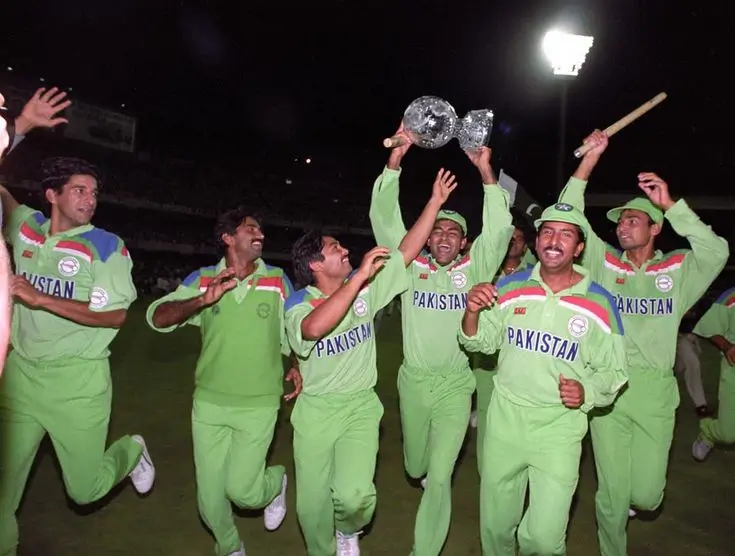
The Soul Pakistani Cricket Legends
Although England invented cricket, few nations have shaped the soul, rhythm, and mythology of the game as profoundly as Pakistan. Cricket may have been born in the English countryside, but it achieved its fullest poetry in the rugged streets of Karachi, the dusty grounds of Lahore, the echoing valleys of Peshawar, and the sun-burnt alleys where barefoot children dream beneath the green crescent flag.
Pakistan is one of the rare nations where cricket is not merely a sport — it is an identity, a heartbeat, a shared language, a place of escape, and a sanctuary of dreams.
In Pakistan, cricket is a memory passed from father to son, mother to daughter; celebrated through radios in tea shops, televisions in village courtyards, and giant screens in glittering cities. The country’s passion for the sport runs so deep that generations measure their lives not by years, but by eras:
- The Hanif Era — The Age of Patience
- The Imran Era — The Age of Glory
- The Wasim–Waqar Era — The Age of Fire
- The Younis–Yousuf Era — The Age of Elegance
- The Afridi Era — The Age of Madness
- The Babar Era — The Age of Modern Brilliance
Pakistan has contributed something rare to the game: Pakistani cricketers who are artists, warriors, mystics, rebels, geniuses, and magicians — often all at once.
The Birth of a Cricketing Nation (1952) & Pakistani Cricket Legends
Pakistan received Test status on 28 July 1952, only five years after its formation. Barely in its infancy as a nation, Pakistan stepped onto the international stage with no large infrastructure, minimal resources, and a fragile cricketing system held together almost entirely by raw passion.
Their first Test match took place at the old Feroz Shah Kotla Stadium (now Arun Jaitley Stadium) in India in October 1952. They lost by an innings and 70 runs — but something more important happened: The world noticed Pakistan’s spirit.
Pakistan was a nation learning to walk. Its Pakistani cricketers were learning to fight. Within years, they became giant-killers.
The PCB Hall of Fame – A MUSEUM OF PAKISTANI CRICKET LEGENDS
In April 2021, the Pakistan Cricket Board created the PCB Hall of Fame — not just as a ceremonial gesture, but as a living archive of Pakistan’s cricket history.
Cricket in Pakistan has always needed preservation — not because its glory is forgotten, but because its stories are too grand, too wild, too emotional to remain only in memory. The Hall of Fame is an attempt to immortalize these Pakistani Cricket legends.
The first inductees were six Pakistanis who had already entered the ICC Cricket Hall of Fame: Hanif Mohammad, Imran Khan, Javed Miandad, Wasim Akram, Waqar Younis, and Zaheer Abbas. These six built the spiritual architecture of Pakistan cricket.
Every year on 16 October, the day Pakistan played its debut Test, two new Pakistani Cricket legends are inducted — a symbolic ritual linking the nation’s present to its origins.
Why Pakistani Cricketers Become Pakistani Cricket Legends
Pakistan doesn’t produce ordinary cricketers. Pakistan produces characters in Pakistani Cricket.
Why? Because Pakistani cricket is born not from academies, but from chaos, improvisation, and pure instinct. Many of the game’s most innovative techniques emerged from Pakistan’s unconventional soil:
- Reverse swing — perfected by Wasim & Waqar
- Doosra — invented by Saqlain Mushtaq
- Teesra — a Pakistani variation
- The modern leg-spin revival — credited to Abdul Qadir
- Unorthodox variations in pace bowling — from Shoaib Akhtar to Mohammad Asif
- Free-flowing street batting — from Miandad to Afridi
Pakistani cricketers are born from the streets, not classrooms. From tape-ball wars, not neat coaching drills. From adversity, not luxury. This gives them an edge no nation can replicate: raw genius.
The Cricket Legends Begin – Profiles of the 20 Greatest Pakistani Cricketers
This is where the soul begins to burn — where artistry meets aggression, elegance meets electricity, and ordinary men rise into immortal figures. This is the era where Pakistan did not just play cricket; they reinvented it.
Pakistani Cricketers: The Architects of the Fire (Pace and Spin)
1. Wasim Akram: The Sultan of Swing
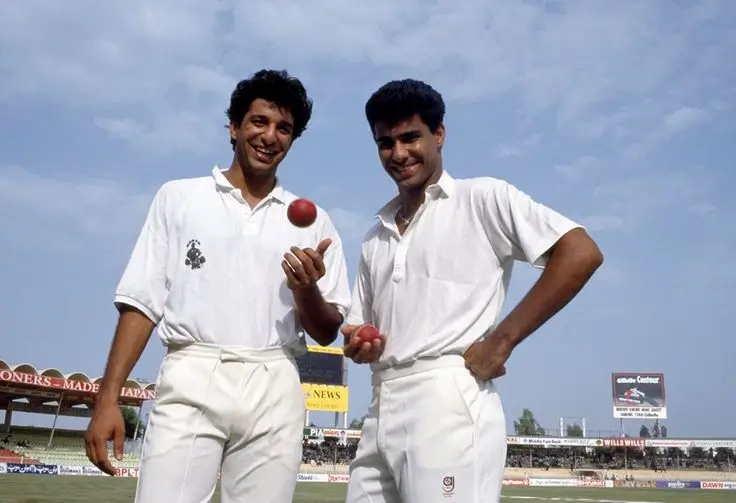
“He did not bowl balls. He painted with them.” There are many fast bowlers in cricket history, but there is only one Wasim Akram — a bowler so sublime, so devastating, so breathtakingly unpredictable that even the greatest batsmen would walk out with silent prayers on their lips.
Wasim Akram was not manufactured. He was discovered — like a hidden treasure buried in the alleys of Lahore. Imran Khan saw something in him — something wild, something dangerous, something extraordinary. In Wasim, he saw a once-in-a-century genius.
His Legacy: He made the cricket ball break the laws of physics. Reverse swing existed before him, but Akram perfected it, turning it from a novelty into a weapon. His yorkers were not deliveries — they were declarations. Toe-crushers delivered at 150 kph, inswinging bullets, outswinging daggers. He was the first in history to reach 500 ODI wickets, and his iconic spell in the 1992 World Cup Final sealed Pakistan’s victory. His aura was unmatched in Pakistani Cricket.
2. Waqar Younis: The Bolter, The Executioner, The Reverse-Swing Warrior
If Wasim Akram was art, Waqar Younis was violence. Raw, beautiful, destructive violence. Together, they formed cricket’s most terrifying duo: WASIM + WAQAR = THE TWO W’s. A pair so fearsome that entire batting lineups would crumble.
His Legacy: He was the Yorker King. Before Waqar, yorkers were risky. Waqar turned the yorker into a weapon of mass destruction. It hunted toes like a guided missile. Among bowlers with over 350 Test wickets, only Dale Steyn has a better strike rate than Waqar’s statistically insane $43.4$. He was a teenager terrorizing the world’s best batters, proving that pace can be intelligent and aggression can be elegant.
3. Imran Khan: The Skipper, The Great Cricket Legend
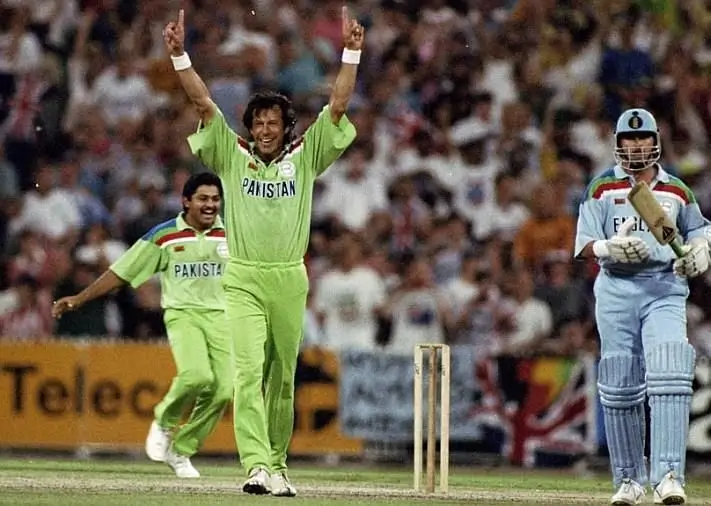
Imran Khan was more than a Pakistani cricketer; he was an icon, a revolutionary leader, and one of the greatest all-rounders in the game’s history. He instilled in Pakistan the belief that they could win against any opponent, anywhere.
His Legacy: Captain of the 1992 Cricket World Cup-winning team. His motivational speech about being
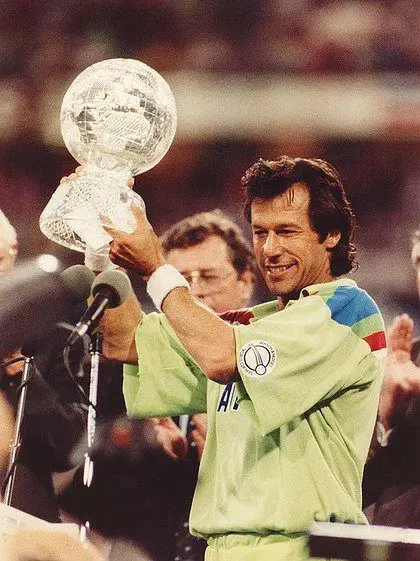
“Cornered Tigers” became legendary. He achieved the rare Test match “All-rounder’s Triple,” scoring over 3,000 runs and taking over 300 wickets. Finishing his Test career with a bowling average of $22.81$, he was instrumental in mentoring and discovering future Pakistani Cricket legends like Wasim Akram and Waqar Younis.
4. Shoaib Akhtar: The Rawalpindi Express: Speed, Rage & The Art of Fear
Shoaib Akhtar, Pakistani Cricket Legend, was not a bowler. He was a natural disaster. Crowds came to witness speed itself being broken. In 2003, he delivered the world’s first $161.3 \text{ km/h}$ (100.23 mph) ball — a record that still symbolizes the limits of human potential.

His Legacy: His run-up was a cinematic scene—a charging lion. His celebration was war thunder. He was controversial, unpredictable, and brilliant. His rivalry with Sachin Tendulkar was the ultimate duel. He gave cricket something rare: pure, unfiltered fear.
5. Mohammad Asif: The Seam Magician
Some players are remembered for what they accomplished, but a few rare ones—like Mohammad Asif—are remembered for what they could have become. Asif was, quite simply, the most intelligent bowler Pakistani Cricket ever produced.
His Legacy: His mastery of seam, swing, rhythm, deception, and angle was so exquisite that many experts declared him the best new-ball bowler since Glenn McGrath. He dismissed the best in the world with ease: Ponting, Kallis, Pietersen. With 106 wickets in 23 Tests, his average of $24.4$ places him among Pakistan’s finest statistical bowlers, though his story remains one of the greatest “what if” tales in cricket history.
6. Saqlain Mushtaq: The Inventor, The Doosra Master
Before Saqlain Mushtaq, off-spin was predictable. Then Saqlain arrived—with a gentle smile and a mind sharp enough to rewrite Pakistani cricketing history.
His Legacy: He invented the “Doosra,” the delivery that spun the opposite way to standard off-breaks—revolutionizing spin bowling. He was the fastest in history to reach 200 ODI wickets. His mastery inspired a generation of spinners globally, including Muralitharan and Harbhajan Singh. He is the father of the modern off-spin revolution.
7. Abdul Qadir: The Magician of Leg-Spin
When fast bowling ruled the world, Abdul Qadir dared to be different. He bowled leg spin when leg spin was dying. He brought mystery back to cricket.
His Legacy: He didn’t just spin the ball—he danced with it. His theatrical action and repertoire of variations revived an art form that inspired Shane Warne, who cited him as his hero. With 236 Test wickets, he proved that leg spin is poetry.
8. Sarfaraz Nawaz: The Reverse Swing Pioneer
Before Wasim, before Waqar, there was Sarfraz Nawaz—a man so far ahead of his time that cricket didn’t understand him until a decade later.
His Legacy: He discovered Reverse Swing by accident. His most famous spell—7 wickets for 1 run against Australia in 1979—turned a certain loss into a famous win. Without Sarfraz, Pakistan’s fast-bowling legacy loses its foundation. He is the grandfather of the fast-bowling dynasty.
The Pillars of Patience and Purity (Batting Pioneers)
9. Hanif Mohammad: The Little Master, The Iron Man of Karachi
The original “Little Master,” Hanif was the foundation upon which Pakistan’s early identity was built.
His Legacy: Holder of the longest innings in Test match history: a marathon 337 runs over 970 minutes (over 16 hours) against the West Indies in 1958, saving the match. He set the then-world record for the highest individual score in First-Class cricket with 499. He became a symbol of defiance and endurance for a new nation.
10. Zaheer Abbas: The Asian Bradman
If cricket had a poet of elegance, his name would be Zaheer Abbas. He wasn’t just technically sound—he was technically divine. Cricket experts called him “The Asian Bradman,” a title no other Asian batsman has ever been given.
His Legacy: The only Asian batsman to score 100 first-class centuries. He was the first batsman in ODI history to score three consecutive centuries. His $274$ against England in 1971 at Edgbaston was an exhibition of grace. He became the blueprint for every elegant Pakistani batsman after him.
11. Javed Miandad: The Street Fighter, The Master of Mentality
If Hanif was the patient foundation, Miandad was the ultimate fighter: stubborn, fiercely competitive, and possessing a cricketing brain unrivaled.
His Legacy: He played in a record-equaling six ICC Cricket World Cups. His most iconic moment was hitting a six off the last ball against India in the 1986 Austral-Asia Cup Final in Sharjah, a shot that cemented his status as a clutch player and Pakistani hero. He finished with a remarkable Test average of $52.57$.
12. Saeed Anwar: The Elegant Aggressor, The Poet of the Cover Drive
If batting is art, Saeed Anwar was a painter. Elegant, calm, effortless, graceful.
His Legacy: Held the World Record for the highest individual score in ODI cricket for almost 13 years (a spectacular 194 against India in 1997). His true legacy is the aesthetic beauty of his batting—the whisper of his timing, the caress of his drives. He remains one of the most iconic left-handed openers.
13. Mohammad Yousuf: The Artisan who Painted Runs
Where Younis was the wall, Mohammad Yousuf was the painter, crafting beautiful, mesmerizing innings.
His Legacy: Holds the World Record for the most Test runs in a calendar year, scoring an astonishing 1,788 runs in 11 Tests in 2006 and setting the record for the most international centuries in a calendar year (9). He finished his Test career with a remarkable average of $52.29$, combining classical technique with modern aggression.
14. Younis Khan: The Crisis Man, The 10,000-Run Peak
Younis Khan was the unshakeable rock of Pakistan’s middle order, defined by resilience and his ability to convert half-centuries into monumental hundreds.
His Legacy: The only Pakistani batsman to score over 10,000 runs in Test cricket (10,099 at an average of $52.05$). He is the only batsman in the world to score a century in all 11 Test-playing nations. He was the rock, the patriarch of Pakistan’s most consistent batting era.
Pakistani Cricket Legends: The Modern Era (Resilience and Redefinition)
15. Misbah-ul-Haq: The Architect of Stability, Captain Cool
Misbah-ul-Haq was the rock and the most successful Test captain in Pakistan’s history, taking over during a period of immense turmoil.
His Legacy: Pakistan’s most successful Test captain, with 26 wins and an incredible 50% win rate. He led Pakistan to the No. 1 ranking in Test cricket (2016) while playing all home games in the UAE. His calm temperament rebuilt the team’s reputation through discipline and patience.
16. Shahid Afridi: Boom Boom, The Untamed Soul
If Pakistani cricket had a heartbeat, fire, and madness, that heartbeat would be Shahid Afridi. He was not consistent, but he was magic.
His Legacy: Held the record for the fastest ODI century (37 balls) for nearly two decades. Took over 500 wickets and scored over 10,000 runs in international cricket. He was a gladiator in green, swinging his bat like a sword, and became the crowd’s fictional superhero, representing boldness and freedom.
17. Babar Azam: The Modern Maestro
Babar Azam is the current face of Pakistan cricket, representing a return to classical orthodoxy combined with 21st-century scoring rates.
His Legacy: The fastest Asian batsman to reach 3,000, 4,000, and 5,000 ODI runs. Known for his technical brilliance and sublime cover drives, he is the spiritual successor to the elegance of Yousuf and the consistency of Younis, establishing himself as a modern “Fab Four” contender.
18. Moin Khan: The Fighter behind the Stumps
Moin Khan was the fiery, animated, and relentless wicketkeeper-batsman whose energy was the visible heartbeat of the team during the 1990s and early 2000s.
His Legacy: Known for fast, clinical keeping, especially standing up to the pace of Wasim and Waqar. He was a gritty lower-order batsman, famous for his timely interventions and his match-winning aggression, proving that energy and vocal leadership are essential.
19. Mushtaq Ahmed: The Spin Twin
Mushtaq Ahmed was the energetic leg-spinner who partnered with Saqlain Mushtaq to create one of the most effective spin duos in world cricket.
His Legacy: Known for his aggressive variations, classical loop, and sharp turn. A key member of the 1992 World Cup-winning squad and a phenomenal success in English County Cricket. His attacking temperament and mastery of the googly made him a massive wicket-taker.
20. Mushtaq Mohammad: The Artist Who Could Do Everything
Batting? Yes. Bowling? Yes. Captaincy? Yes. Mushtaq Mohammad was a man who played cricket like a grandmaster plays chess.
His Legacy: Debuted at just 15 years old. A complete all-rounder who could play long innings, bowl leg-spin and googlies, and lead like a tactician. He is the intellectual father of Pakistan’s tactical cricketing brain, influencing Imran Khan and Miandad with his comprehensive understanding of the game.
The Indelible Legacy of Pakistani Cricket
The story of these 20 Pakistani Cricket legends traces the arc of Pakistani cricket—from the patient resilience of the Hanif Era to the modern brilliance of Babar Azam. They represent the soul, the chaos, the genius, and the passion that make Pakistan’s contribution to the game so unique and indelible.
A Nation’s Love
Cricket is Pakistan’s heartbeat. It unites cities, provinces, and hearts. From Karachi to Peshawar, Multan to Lahore, every alley, street, and stadium vibrates with Pakistan cricketing energy. Pakistani Cricket love is the fuel that has driven the genius.
The Three Pillars of Pakistan Cricket
- Innovation (The Genius): Pakistan has always led the world in cricketing invention, not imitation. The perfection of Reverse Swing, the invention of the Doosra, and the revival of Leg Spin stand as towering technical contributions to the global game.
- Unpredictability (The Madness): The team’s glorious inconsistency—the ability to lose badly one day and beat the world champions the next—is not a flaw, but a central feature. It is this volatility, embodied by stars like Shahid Afridi, that makes watching Pakistan a high-stakes, emotional gamble, thrilling millions globally.
- Resilience (The Hustle): Born in the chaos of a young nation, Pakistani cricket has always been about fighting back. From Fazal Mahmood’s Oval victory in 1954 to Imran’s “Cornered Tigers” in 1992, the story is one of overcoming adversity through raw skill and unbreakable pride.
Pakistan cricket is more than statistics; it is the most passionate, raw, and beautiful expression of the game on Earth—a perpetual dance between chaos and genius.
Today, Pakistan cricket is a living legacy, continuously evolving. The spirit of Pakistan cricket—its heart, hustle, and heroism—remains undiminished, reminding the world that this is a nation where cricket is not just a game, but a way of life.
In the end, Pakistani cricket is a story of resilience, brilliance, and passion—a story that transcends generations, stadiums, and borders. From its earliest heroes to its modern maestros, Pakistan has produced legends who will forever inspire, teach, and thrill cricket fans around the world.
Pakistan cricket is not just remembered; it is celebrated, cherished, and immortal
FAQs –“Forever Top 20 Pakistani Cricket Legends“
1. Who are considered the greatest Pakistani cricket legends of all time?
Pakistan has produced many cricket legends, including icons like Wasim Akram, Imran Khan, Javed Miandad, and Younis Khan, known for their outstanding contributions in international cricket.
2. What makes Wasim Akram a legendary Pakistani fast bowler?
Wasim Akram is widely regarded as one of the greatest fast bowlers in cricket history, excelling in reverse swing and taking over 400 international wickets for Pakistan.
3. Why is Imran Khan featured among Pakistan’s top cricket legends?
Imran Khan is celebrated not only as a great all-rounder with significant bowling and batting contributions but also for leading Pakistan to its first Cricket World Cup victory in 1992.
4. Who was Javed Miandad and what are his major achievements?
Javed Miandad is a legendary batter for Pakistan known for clutch performances and record-setting achievements in ODI and Test cricket, including multiple centuries and memorable match-winning innings.
5. How did Younis Khan make history in Pakistan cricket?
Younis Khan is renowned as one of Pakistan’s most successful Test batsmen, becoming the only player to score a Test century against all 11 Test-playing nations.
6. Is Babar Azam considered one of Pakistan’s modern cricket legends?
Yes — Babar Azam’s consistency across all formats and recent milestones like joining an elite group with 15,000 international runs highlight his status among modern Pakistani cricket greats.
7. Which Pakistani bowlers are celebrated as all-time greats?
Legends like Waqar Younis and Shoaib Akhtar are celebrated for their fast bowling prowess, pace, and match-impacting spells throughout their international careers.
8. What role did Saqlain Mushtaq play in Pakistan’s cricket legacy?
Saqlain Mushtaq is credited with innovating the “doosra” delivery, influencing spin bowling globally and earning him a place among Pakistan’s legendary cricketers.
9. Which Pakistani wicket-keeper captains are regarded as legends?
Sarfaraz Ahmed is remembered as a successful captain and wicket-keeper who led Pakistan to ICC Champions Trophy success and made significant contributions with the bat.
10. Are women cricketers included among Pakistan’s cricket legends?
Yes — Sana Mir, the first Pakistani woman inducted into the ICC Hall of Fame, stands among the nation’s cricket legends for her leadership, batting, and bowling achievements.